OTHER PAGES ON THE LEAFLET

Sunday, August 09, 2015

ORIGINS II

In this month of anniversary of the founding of our Red Maple Sangha, I offer some historical reflections on our origins


As with many insights, once I determined that I would establish a local practice community, it immediately seemed to be correct has to follow. Deciding not to affiliate with a distant group felt like stepping into a dark room, literally a leap of faith. I knew that there were other groups operating independently, but there was no instruction manual, no step-by-step program which would direct me into a guarantee of success.
Back in my home county, I began to discuss with a few individuals with whom I had practised was a possibility of an ongoing group. Initially, we decided on a monthly discussion/study format. Because we were intending to be a Buddhist group, not simply a meditation group, it seemed that raising people's understanding of Buddhist teaching was an important place to start. This was the beginning of The Turning Wheel Buddhist Study Group and, once a month, we were meeting on Sunday evenings in a small church space in Almonte.

For the following year, we explored the basics of Buddhadharma - the Four Noble Truths, The Eight Steps to Satisfaction, some history of the Buddha and Buddhism and an introduction to Buddhist art. Very soon we made the decision that we needed to venture more directly in Buddhist practice. Most of the group were former participants from mindfulness courses, so this was not a huge leap.


By the end of that year of Turning Wheel, we relocated our activities to Carleton Place and used a borrowed massage therapist's room for once weekly evening sessions. Our practice was primarily sitting zazen - what I knew best - and occasional walking. It was this that became the start of the Red Maple Sangha. I chose the name because it resonated so well with the maple history of the county and captured some thing of the quintessential Canadian-ness of our endeavour.

Next week: Red Maple Sangha Expands

Yours in the Dharma,                          
Innen, doshu
om namo amida butsu  

Saturday, August 01, 2015

ORIGINS I

In this month of anniversary of the founding of our Red Maple Sangha, I offer some historical reflections on our origins

In the summer of 2004 I traveled to Vermont to experience a personal retreat in a Zen monastery. The location was beautiful, purposeful and the practice experience was familiar to me, having spent most of the prior decade in a Zen environment. As I drove away I had every intention of restoring my connections with Zen-shu after nearly 5 years of no affiliation with any particular sangha. The only other experience I had in those intervening years was some very fulfilling study with a Pure Land group. I felt that a good sangha was worth the 500 mile trip several times annually.
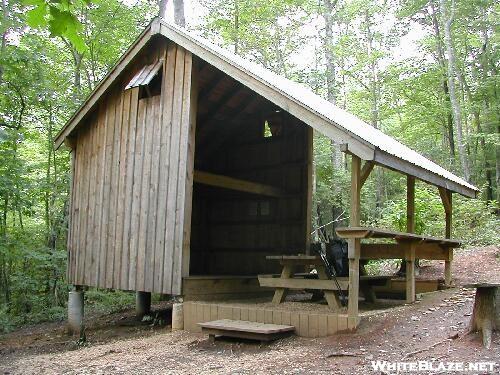
On leaving the monastery I had decided to add on a few days of walking in the Adirondacks. I chose the Green Mountains because it meant easy access to the legendary Appalachian Trail and promised some challenging forest walks. The main day walk was a few hours up a gradual forest slope to one of the many shelters provided on the Trail. I reached it and rested to have my lunch and enjoy the view over the mountain-top lake, on which the shelter stood.

http://whiteblaze.net/forum/vbg/files/4/1/ga_-_gooch_mountain_shelter.jpg
Typical Appalachian shelter

In early afternoon it was time to return back down the trail and I was mulling over the future of visits to this region for a new sangha. As I walked, and in spite of a few inglorious slides across rain-slicked rock-faces, I wondered if my leanings towards this distant sangha were the right one. I reflected back over the past few years and my isolation from an active sangha, on my early experiences with driving from Lanark to Montreal every month for practice connection and a growing awareness of the vow we all take to present the Dharma where we find ourselves.

Next week: Germ of a Sangha

Yours in the Dharma,                          
Innen, doshu
om namo amida butsu   

Saturday, July 25, 2015

NEW RESOURCE: JAANUS

 
In browsing last week I came across a new resource for those of us interested in Japanese Buddhism. The site is at: http://www.aisf.or.jp/~jaanus/

JAANUS is the on-line Dictionary of Japanese Architectural and Art Historical Terminology compiled by Dr. Mary Neighbour Parent, an American art historian with a long and distinguished career in Asian art.
This dictionary contains approximately 8000 terms related to traditional Japanese architecture and gardens, painting, sculpture and art-historical iconography from approximately the 1st century A.D. to the end of the Edo period (1868). Terms from related fields such as lacquer, ceramics, textiles and metalwork have been included where they are considered to be of general interest and/or impact on the principal fields of architecture, painting and sculpture. These definitions are not translations from any one Japanese monolingual dictionary, but have been collated from a range of specialist sources and scholarly publications, and from direct observation and study. Many have never before been defined in English.
This is not a definitive work. Although every effort has been made to create as accurate a compilation as possible, new discoveries will, most likely, complement our endeavor. However, new discoveries can sometimes negate old findings, facts or myths. Therefore, should you find discrepancies or errors, let us know as any corrections can benefit all.

While this is not a source for Dharma terms, it reflects the overlap between Japanese Buddhism and art,  with a great deal of similar terminology.

Yours in the Dharma,                          
Innen, doshu
om namo amida butsu  
 

Sunday, July 19, 2015

THE SACRED MOUNTAIN

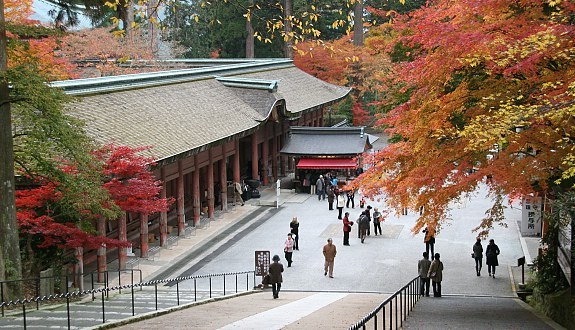
Our Tendai tradition began some 1200 years ago when our Dharma grandfather, Saicho, established his main temple in the mountains above the main cities of Nara and Kyoto, overlooking beautiful Lake Biwa. Hie-zan (Mount Hiei) has been the home for Tendai ever since and comprises dozens of small and large temples and shrines, all spread over an expansive natural landscape. The entire grounds of Hiezan Enryakuji is thousands of acres of natural mountain and forest, which was designated by the UN as a world cultural and heritage site in 1994. I can attest to the stunning beauty of The Mountain, as it is called locally. My visit in 2013 left me with powerful impressions and memories of our own Dharma home.

 
If you would like some detail and images of the site and many of the buildings on Enryakuji, here is an official brochure which provides photos and description.

http://www.hieizan.or.jp/_att/english.pdf


Yours in the Dharma,                          
Innen, doshu
om namo amida butsu   
Sunday, July 12, 2015

TENDAI AND THE ZO TWINS

At our Thursday sitting we were discussing our favourite twins, Jizo and Kokuzo. Jizo (Earth Storehouse) represents the Six Realms of Material Being, and, as expressed in the Sutra of Earthstore Bodhisattva, his promise is to travel through all six realms until all beings are liberated. Kokuzo, The Realm of Infinite Possibilities, represents potentiality, that which is yet to be manifested. These two have been part of our learning and practice for years and in their relationship we can see the fundamental philosophical stance of Tendai - the Way of Harmony.

Image result for mizuko jizo 
Mizuko Jizo

Image result for kokuzo
Kokuzo
 
Tendai as expounded by both Chi-ih and Saicho proposes that we can understand our experience through three perspectives - the conventional (the world is just as we see it, nothing more), the absolute (the world as we experience it is just illusory) and the harmonious reconciliation of these two views. Like wise, Jizo is the world as we see it and Kokuzo is the yet-to-be world, and their twin-ship illustrates how these apparent opposites can be related.
Interestingly too is the adoption of each of these by different Japanese sects. The Pure Land (Jodo) sect which emphasizes a personal and devotional relationship practice views Jizo as a manifestation of Amida. Anyone who experiences the Japanese landscape will of course encounter Jizo, with his red hats and scarves, in innumerable sites around temples and even in secular sites. Both Jizo (as the guardian of death) and Amitabha (as the Lord of the Western or Sunset Land) emphasize the sun setting in the west. On the other hand, Shingon, the predominantly esoteric tradition which holds that Buddhas are beyond any human experience except through symbolic means incorporates Kokuzo. He is associated with the East and the rising sun and morning star.

Yours in the Dharma,                          
Innen, doshu
om namo amida butsu

Tuesday, June 02, 2015

BUDDHISTS BEARING GIFTS

We welcomed a new Dharma friend last week.  Alan McAllister is a practitioner from the Bancroft area who has reached out to our sangha. He and his wife, Ilda, joined us for practice and a wonderful exchange of ideas.
Alan brought with him a couple of first-rate additions to our library:

  • Experience The Dharma, by Bhikkhu Khippapanno. This is a solid presentation of Theravadin teaching combined with a Q/A section. This teacher is from the Burmese Mahasi tradition. Very thorough.
  • The Attentive Mind Workbook: Self-healing Through Meditation is Alan’s original book. The book is divided into four parts: Finding Happiness Amidst Suffering; The Paths to Mental Suffering; The Path to Liberation from Mental Suffering and The Path to Happiness. This a mix of familiar ideas and lots of Alan’s original thought based on decades of Dharma practice, especially meditation.

The Attentive Mind Workbook 

To learn more about Alan's work and services:  http://www.attentivemind.ca/index.html

We look forward to sharing and practicing with these friends again soon.

Yours in the Dharma,                          
Innen, doshu
om namo amida butsu