OTHER PAGES ON THE LEAFLET
At our Thursday sitting we were discussing our favourite twins, Jizo and Kokuzo. Jizo (Earth Storehouse) represents the Six Realms of Material Being, and, as expressed in the Sutra of Earthstore Bodhisattva, his promise is to travel through all six realms until all beings are liberated. Kokuzo, The Realm of Infinite Possibilities, represents potentiality, that which is yet to be manifested. These two have been part of our learning and practice for years and in their relationship we can see the fundamental philosophical stance of Tendai - the Way of Harmony.
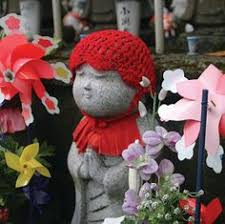 Mizuko Jizo
 Kokuzo
Tendai as expounded by both Chi-ih and Saicho proposes that we can understand our experience through three perspectives - the conventional (the world is just as we see it, nothing more), the absolute (the world as we experience it is just illusory) and the harmonious reconciliation of these two views. Like wise, Jizo is the world as we see it and Kokuzo is the yet-to-be world, and their twin-ship illustrates how these apparent opposites can be related.
Kokuzo
Tendai as expounded by both Chi-ih and Saicho proposes that we can understand our experience through three perspectives - the conventional (the world is just as we see it, nothing more), the absolute (the world as we experience it is just illusory) and the harmonious reconciliation of these two views. Like wise, Jizo is the world as we see it and Kokuzo is the yet-to-be world, and their twin-ship illustrates how these apparent opposites can be related.
Interestingly too is the adoption of each of these by different Japanese sects. The Pure Land (Jodo) sect which emphasizes a personal and devotional relationship practice views Jizo as a manifestation of Amida. Anyone who experiences the Japanese landscape will of course encounter Jizo, with his red hats and scarves, in innumerable sites around temples and even in secular sites. Both Jizo (as the guardian of death) and Amitabha (as the Lord of the Western or Sunset Land) emphasize the sun setting in the west. On the other hand, Shingon, the predominantly esoteric tradition which holds that Buddhas are beyond any human experience except through symbolic means incorporates Kokuzo. He is associated with the East and the rising sun and morning star.
Yours in the Dharma,
Innen, doshu
om namo amida butsu
We welcomed a new Dharma friend last week. Alan McAllister is a practitioner from the Bancroft area who has reached out to our sangha. He and his wife, Ilda, joined us for practice and a wonderful exchange of ideas.
Alan brought with him a couple of first-rate additions to our library:
- Experience The Dharma, by Bhikkhu Khippapanno. This is a solid presentation of Theravadin teaching combined with a Q/A section. This teacher is from the Burmese Mahasi tradition. Very thorough.
- The Attentive Mind Workbook: Self-healing Through Meditation is Alan’s original book. The book is divided into four parts: Finding Happiness Amidst Suffering; The Paths to Mental Suffering; The Path to Liberation from Mental Suffering and The Path to Happiness. This a mix of familiar ideas and lots of Alan’s original thought based on decades of Dharma practice, especially meditation.
 To learn more about Alan's work and services: http://www.attentivemind.ca/index.html
We look forward to sharing and practicing with these friends again soon.
To learn more about Alan's work and services: http://www.attentivemind.ca/index.html
We look forward to sharing and practicing with these friends again soon.
Yours in the Dharma,
Innen, doshu
om namo amida butsu
I’m always thrilled to find another exceptional rare Dharma book for free online. The latest treasure for me came as I was looking to answer a question I had about what ethical advice we might find for our secular lives within Asian monastic traditions. Buddhist Monasticism in East Asia - Places of Practice ; Edited by James A. Benn, Lori Meeks, James Robson is an anthology of scholarly essays loosely tied together around the theme of monasteries and monastic life in mediaeval Japan. The book would be invaluable for the opening summary alone - Neither Too Far, Nor Too Near: The Historical and Cultural Contexts of Buddhist Monasteries in Medieval China and Japan, Robson reviews the various critical perspectives on Japanese Buddhism, especially the distinction between the New Kamakura Buddhism and the Esoteric-Exoteric Establishment theories. He covers the developments of ideas of monasticism in Europe and Asia as well.
Other essays included are:
1. Taking a Meal at a Lay Supporter’s Residence: The Evolution of the Practice in Chinese Vinaya Commentaries; Koichi Shinohara
2. Monastic Spaces and Sacred Traces: Facets of Chinese Buddhist Monastic Records; James Robson
3. Pictorial Program in the Making of Monastic Space: From Jing’aisi of Luoyang to Cave 217 at Dunhuang ; Eugene Wang
4. The Monastery Cat in Cross-cultural Perspective: Cat Poems of the Zen Masters; T.H. Barrett
5. The Monastic Institution in Medieval Japan: The Insider’s View ; William Bodiford
6. Vows for the Masses: Eison and the Popular Expansion of Precept-Conferral Ceremonies in Premodern Japan; Lori Meeks
7. Koen and the “Consecrated Ordination” Within Japanese Tendai; Paul Groner
All of the titles are equally high quality from some of the finest Buddhologists around. For those of us in the Tendai line, Paul Groner is one of our clearest and most important English voices. Not all of the essays are equally captivating (for me at least), however, they all provided rare contributions tor my understanding of Japanese Buddhism. I recently re-read Suzuki’s 1934 classic on Zen monasticism, and the contrast between it, and its many romanticized and narrow notions of monastic life and this anthology is refreshing. This book brings a balance and realism to the forms and functions of Japanese monastic life.
I could not track down the exact download link, but I can send you a copy (PDF, 1.0 MB).
Yours in the Dharma,
Innen, doshu
om namo amida butsu
This is the period when we celebrate Vesak, the birth of our lineage ancestor, Shakyamuni, the historical Buddha. At this time each year, dharma practitioners all over the world recall his life and his teaching.
How could we imagine our world without the arrival and presence of this person? Consider how many nations have built their identity on his life and teaching, how many people have set their live-course from his inspiration. No less than any other tradition, nation or Dharma practitioner, we in the Tendai family offer great bows and gassho for his life!
Milestones:
We mark the passing of one of our beloved sangha members. Kojun Janet Sciba passed away April 23rd, after a year and a half of treatments for a brain tumour. Kojun was a rare person, dedicated to the Dharma, especially her loving Kwan Yin. I had the honour of co-leading the memorial on May 9 and it was very moving to be part of the remembrances of her family.
We also mark the passing of Keisho V K Leary, the founder and abbot of the California Tendai Monastery in Cobb, California. I had the pleasure of meeting Keisho and completed several gyo-trainings with him. He was dedicated to promoting the esoteric practices of our tradition and created a goma-dan ( building for performing the goma or Fire Ceremony) on the precincts of the monastery. A huge loss to Tendai and Western dharma. There is a lovely memorial on the Tendai websites Shingi posting.
http://www.tendai.org/
Yours in the Dharma,
Innen, doshu
om namo amida butsu
Let me respectfully remind you:
Life and death are of supreme importance,
Time swiftly passes by and opportunity is lost.
Each one of us should strive to awaken -
Awaken!
Take heed.
Do not squander your life.
We’ve had much cause to reflect on this famous verse over the past few weeks. We have had two sad and painful losses in our small and large sangha. These remind us that the dharma we study and practice is more than a moral guide for our day to day lives. Too often people reduce religious life to “being a good person”. This is certainly good advice but the teaching which makes up our religious life is more than that. It is exactly this matter of supreme importance - life and death.
Our practice calls us to come face-to-face with our mortality and the inescapable fact of that “ticking clock” in the lives of everyone we care about. As Buddhists, we toss around the term “impermanence” and it can become a philosophical abstract unless we come back again and again to it as the fact of our own lives.
As these past few weeks have reminded us, we will experience the passing of so many of the people who inhabit our lives - we will observe the decline and unraveling of our own lives. Watching a beloved sangha member fade into silence was a complex and wonder-filled experience. It brought me back once more to this great matter of life and death.
I gassho to all those who presented this teaching.
Yours in the Dharma,
Innen, doshu
om namo amida butsu
1. RENFREW WEEKNIGHT SERVICE
We’ve decided to initiate a bi-monthly meditation service in Renfrew. Our first session will take place on Thursday, April 30, from 7.00-8.30pm at Innen’s home, 92 Lorne Street N, just behind the Metro in the West end of town. (A few doors away from Tracey’s Dairy). The program will be a familiar service format. We’re experimenting with this location and format to evaluate if we will establish a regular service back in Renfrew.
No experience is necessary and we welcome people of all faiths. Cost is $10.00/session or free for members.
2. VESAK RETREAT
We will hold our annual Vesak Retreat on Saturday, May 16, 9.00am-1.00pm at the RMML site in Pembroke. Vesak is the worldwide celebration of the birth of Shakyamuni, the historical Buddha and the founder of all Buddhist traditions.
This retreat will combine sitting and walking meditation, as well as some EASE movements and contemplations. We request pre-registration so we can provide adequate food for snacks and lunch. Please confirm with me by May 14.
Cost is $30.00
Yours in the Dharma,
Innen, doshu
om namo amida butsu
Just back from an excellent retreat at our New York state head temple. This was the Higan event and we joined some 15 others for a 2-day event with the theme of Buddhist Mindfulness. Participants were all ages and levels of experience and, for the first time, Red Maple brought 4 participants. It wasn’t the nicest weather, with lots of unseasonably cold and snowy days, but nobody seemed disappointed (even if a little weary of the cold). Even the Saturday kokordo walk up Barnaget Road, as chilly as it was, had a nobility and restfulness to it.
We did several structured practices:
- a four viharas reflection
- a contemplation on the Four Foundations
- a walking recitation
and we had several lovely services. Monshin designed a lovely Amitabha service on the Saturday night with a number of unfamiliar gathas that made it interesting.
On the Saturday evening we watched a captivating documentary on the kaihogyo practice of an extraordinary Tendai priest who did that legendary walk of 26 miles, daily for nearly 10 years. I have seen it before but found it no less astounding what dedication an ordinary person can cultivate.
Deep bows to
- Judy B, Jiho and Liz for their companionship and efforts
- Monshin for his leadership
- Shumon for taking such good care of us
- Gyo-sho, the temple assistant for his tireless support. I was especially taken with his drumming during the Heart Sutra.
Yours in the Dharma,
Innen, doshu
om namo amida butsu


