OTHER PAGES ON THE LEAFLET

Friday, October 09, 2015

WHO IS A BUDDHIST?

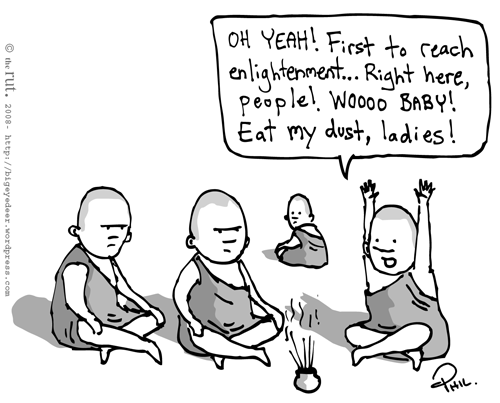
I regularly get articles from mainstream Buddhist magazines. The latest one showed the lamentable state of Dharma dialogue in the West. Supposedly reputable senior teachers describing what qualifies Dharma practitioners as Buddhists. It took the form of "if you accept this...and if you don't accept this..." then you are either in the club or out.

The dharma was taught to free us from the dukkha which characterizes our lives, not to invite us to sign up from some specialness. Surely our Shakyamuni did not "launch" a religious movement with membership and screening processes. The dharma does not have any Platinum Memberships.

I understand that our traditions describe certain people/actions which will have terrible consequences - trying to murder a Buddha, for example.  Nonetheless, how many sutras proclaim the potency of calling out to various Buddhas or Bodhisattvas, no matter what or when, and they assure our future Buddhahood.

It is sad when we are more concerned about being "Buddhists" than realizing the Dharma through our thoughts and actions.  

 http://33.media.tumblr.com/B0IqOxznJ66kk540mne4GLCM_500.gif

Saturday, September 26, 2015

OUTDOOR PRACTICE


When we read about the earliest period of teaching, whether this be the Buddha himself or numerous other teachers, it should not surprise us to realize that teaching and practice happened principally in the outdoors. Yet when we look at practice environments and practice opportunities in the modern period, such outdoor practice has an aura of exoticism, as if it were reserved for the most elite of mystics. There are many reasons for this slanted view of outdoor practice, some of them from with in Buddhist history, some are inherited from the anti-nature philosophies of the modern West.

Beginning in October, we will be designating half of our practices as indoor and half as outdoor. Further, because we will be out of doors half of the time, we will give extra emphasis to walking on those outdoor practice sessions. This means that the first Saturday and the first Thursday of each month will be structured around outdoor practice. The Saturday morning practice will align itself with our sunrise orientation, and so we will base those practice sessions at the covered platform outside of the museum next to the hydroelectric Falls. The walk to this location allows us to cross the celebrated swinging bridge, both coming and going. That practice location also means we are practising against the gentle sounds of the waterfall.

For our evening practices, on the first Thursday of each month, we will likewise align that practice with the sunset and Amitabha practice, including the visualizations that are occupying us this year. We have a couple of potential sites where we can do this practice and over coming months, we will choose the one which allows for the best reviews of the setting sun.

Practitioners will no doubt appreciate that we place ourselves at the mercy of the weather, which in certain seasons can be quite inhospitable. We will attend to the weather and give preference to times when we are not exposed to extremes of cold, snow or heavy rain. All those who attend these practice sessions are provided with a waterproof mat, and a cushion to sit on. Each person should ensure they have sufficient warm and/or weatherproof clothing.

Yours in the Dharma,
Innen, doshu
om namo amida butsu

Sunday, September 13, 2015

WEDDING TALK

I recently had the pleasure of speaking for the wedding of our sangha friend, Jiho. Here is the text I spoke.

This brave and happy couple, Liz and Cam, have kindly asked me to offer some words to this ceremony as a representative of the religious side to this occasion. The first thing to notice about this is that these two acknowledge and value the place of religion in their lives and the significance of this marriage. They agree that, while their individual accomplishments, their material prosperity and their interactions with friends and family enrich their lives, these are not the whole picture.
Every living, growing thing, including a marriage, is grounded in the material, in the day-to-day and the sloppy, messy nourishment of the earth. Equally, this same living thing relies on the insubstantial warmth and heat of the light and air. In my tradition, we teach that religious truth is the interplay between the messiness of this earthly experience and the brilliance of the timeless. For any marriage to thrive and succeed, it needs to attend to all the messes of day-to-day life. There will be jobs to attend, floors to sweep and tears to wipe away. And it needs to look to the symbolic - an anniversary, a daily good-bye kiss and the necessity of dreams shared and dared.
When we consider a marriage as a religious event, we do not bind it to a weekly morning’s service, to following the urgings of any book or to an anxious expectation of some coming reward. Religion is about the sharing of meaning-filled action for what my tradition calls “the benefit of all beings”. As in religion, so in marriage, we are called to strive to make an on-going commitment of selfless service. Marriage like religious life calls us to be our best for another, to contribute to their growth and fulfilment.
May I join all of you gathered here today to wish Liz and Cam many years of such meaning-filled action, such service and the satisfaction which flows from it. Like the living-growing thing I mentioned earlier, let us wish their union thrives and blossoms, season after season.

Sunday, September 06, 2015

MILITANT MONKS

Some really thought provoking writing in the latest Buddha-dharma-Fall Issue Online

I've been reading some stuff lately on the rise of Buddhist monk militancy in Sri Lanka. It began early in the 20th century and was part of the anti-colonial movement lead by Walpola Rahula and others. Tragically the militancy is now growing beyond the historical Sinhala-Tamil conflict into anti-Christian and, even more, anti-Muslim activism


================================================
The Rise of Militant Monks
by Michael Jerryson

http://www.lionsroar.com/the-rise-of-militant-monks/?utm_source=Shambhala+Sun+Community&utm_campaign=8cd93f7eb7-SF_Weekly_Aug_25_20158_25_2015&utm_medium=email&utm_term=0_1988ee44b2-8cd93f7eb7-20858053#

Buddhists Betray the Teachings — Jack Kornfield on the anti-Muslim violence in Burma
by Jack Kornfield| July 14, 2014


http://www.lionsroar.com/buddhists-betray-the-teachings-jack-kornfield-on-the-anti-muslim-violence-in-burma/

Be sure to read the debate in the Comments Section of the Kornfield article. Its really interesting. Fair criticism of Kornfield's viewpoint as a white American.

Yours in the Dharma,                          
Innen, doshu
om namo amida butsu   
Sunday, August 30, 2015

ORIGINS V

Innen at a shinto temple near Kyoto, 2013
Since joining the Tendai family, Red Maple has established itself as the home for Tendai-shu in the Ottawa Valley and in Canada. We have sponsored 5 individuals in completing jukai (refuge taking). In 2013, Innen was invited to attend the international Tendai Symposium in Kyoto, Japan. Along with leaders from sanghas around the world, he presented the growth of Tendai Canada to the leaders of Tendai in Japan. He has participated in several conferences and seminars in Canada and the USA.

Our zendo in the Old Schoolhouse served us for years until 2014, when Judy and Ray decided to sell the property. Because we were attracting a good deal of interest from our neighbouring community of Pembroke, we decided to join with Ray’s business project, Red Maple Mindful Living and his Padakun-Whole Person Walking project in setting up the Red Maple Centre for Mindful Living in a building in Pembroke’s east end. At this site we held weekly practice sessions and several retreat events.
 

With Ray and Judy’s decision to settle in Renfrew, we were presented with the opportunity to return to Renfrew again. Over the summer of 2015 we closed the Pembroke centre and re-established our presence in Renfrew. We begin our 2015-16 season with a new zendo and weekly practice sessions. We have already held our first successful retreat and are growing and learning with an active and dedicated sangha.


As we move into 2016 we continue to be the single permanent presence for authentic Dharma in the Upper Ottawa Valley and rural Eastern Ontario. We have spun off the KAPPS Walking group, two new mindfulness training programs and are launching our Bluebox Walking campaign ( see http://blueboxwalking.blogspot.ca/). Innen is about to begin a year-long study program on the Visualization Sutra and its companion Taimadera Mandala. He is further preparing to present a new online fiction project called Dharma for A Dying World.

Yours in the Dharma,                           
Innen, doshu
om namo amida butsu   

Friday, August 21, 2015

ORIGINS IV

The next stage in our development as a community of practice was our affiliation with the profound and authoritative tradition of Japanese Tendai, which, like our very own Red Maple style is known as the “harmonious way”, ekayana. After a few distant communications, Innen made the first of many trips from Ottawa Valley to the Berkshires in northern New York, to participate in training events with members from similar groups in New York, California, Colorado and even Denmark.

Within a year, Innen was confident that there was sufficient compatibility for Red Maple that he requested he be trained for formal ordination as a Tendai priest. This required his attendance at three summer training programs or gyo, the formal preparation for Tendai priesthood. This he completed in the summer of 2010, returning back to Renfrew County to transform Red Maple into the first Tendai Sangha in Canada.

Innen, doshu at his ordination

Over the next two years five other individuals from Red Maple received jukai or refuge vows, joining Innen as formal members of the international community of Tendai. One of these became the first-ever refuge taker within the Tendai tradition to receive jukai in Canada. In the practice space in the old schoolhouse just outside of Renfrew, we revised our altar so that it reflected the formal style used in Tendai service. We harmonized our practice schedule, chanting guide and practices so that our practice continued the forms established 1200 years ago in Japan.

During this same time, Innen was invited to become the Buddhist commentator for the weekly  Ask the Religion Experts column featured in the Ottawa Citizen newspaper. Every week for nearly 4 years he would join representatives from a dozen other religious traditions and comment on specific questions related to religious life. 


It was also during this time that Innen completed the writing and publication of Walk like a Mountain: the Handbook of Buddhist Walking Meditation, the first book to document the dozen or more walking practices from various Buddhist traditions.

The positive energy of this time for Red Maple inspired two new groups to form. The first was The Flowing Rivers practice group in Ottawa which functioned for two years; the other was the White Birch practice group in Halifax which is still functioning. 


Next: The Present Moment

Yours in the Dharma,                           
Innen, doshu               
om namo amida butsu   


Saturday, August 15, 2015

ORIGINS III

In the mid-2000's we made the decision to re-locate further up the Ottawa Valley into the area just outside of the Town of Renfrew. In the spring of 2005 we set up our practice space in an L-shaped room attached to an old log school house, Ray and Judy’s new home. We continued the same forms of practice and non-affiliation. At the same time, Ray was developing a more active promotion of mindfulness training in his social work, through the Change Your Mind program he had first developed in Lanark. 

This interconnection of practice environments worked in both directions. It gave those interested in Buddhist meditation a well-developed practice instruction program. For some of those who were learning about meditation in a secular environment this would be their entry point into Dharma study. This was a challenge to the group in Carleton Place. Those people tried for a year to maintain their practice but with the moving-away of some key people and the desire to participate more in the “home” base, the Carleton Place group shut down.
This was an exciting and rich time with the introduction of some instructional series and themed retreats. The schoolhouse proved to be a wonderful location, with peaceful walks down to Hurds Lake, several ponds at the entry, magnificent flower and veggie gardens and countless birds singing to us during practice times. All of us grew as practitioners and as a group. We began to feel the need for greater connection with a larger Dharma tradition to give us more guidance and depth. As he had a few years earlier, Ray began searching for a compatible relationship with a more established tradition.

Yours in the Dharma,                          
Innen, doshu
om namo amida butsu